
The outspoken union organizer Frank Little was lynched in Butte, Montana in 1917 during rising tensions between mining companies and the workers. A note was pinned to his body with the numbers 3-7-77, which was a frequently used and enigmatic code for vigilantes. The idea of frontier, vigilante justice is so ingrained in Montana that their highway patrol patch has “3-7-77” embroidered on it—aligning the law enforcement agency with a history of lawlessness, assassinations, secrecy, and terrorism.

The outspoken union organizer Frank Little was lynched in Butte, Montana in 1917 during rising tensions between mining companies and the workers. A note was pinned to his body with the numbers 3-7-77, which was a frequently used and enigmatic code for vigilantes. The idea of frontier, vigilante justice is so ingrained in Montana that their highway patrol patch has “3-7-77” embroidered on it—aligning the law enforcement agency with a history of lawlessness, assassinations, secrecy, and terrorism.
In 1917, the Speculator Fire disaster claimed the lives of 168 miners, spurring renewed unionizing fervor and bringing the labor organizer Frank Little to the region who was later lynched. The company always had to rationalize the loss of life as the cost of business.
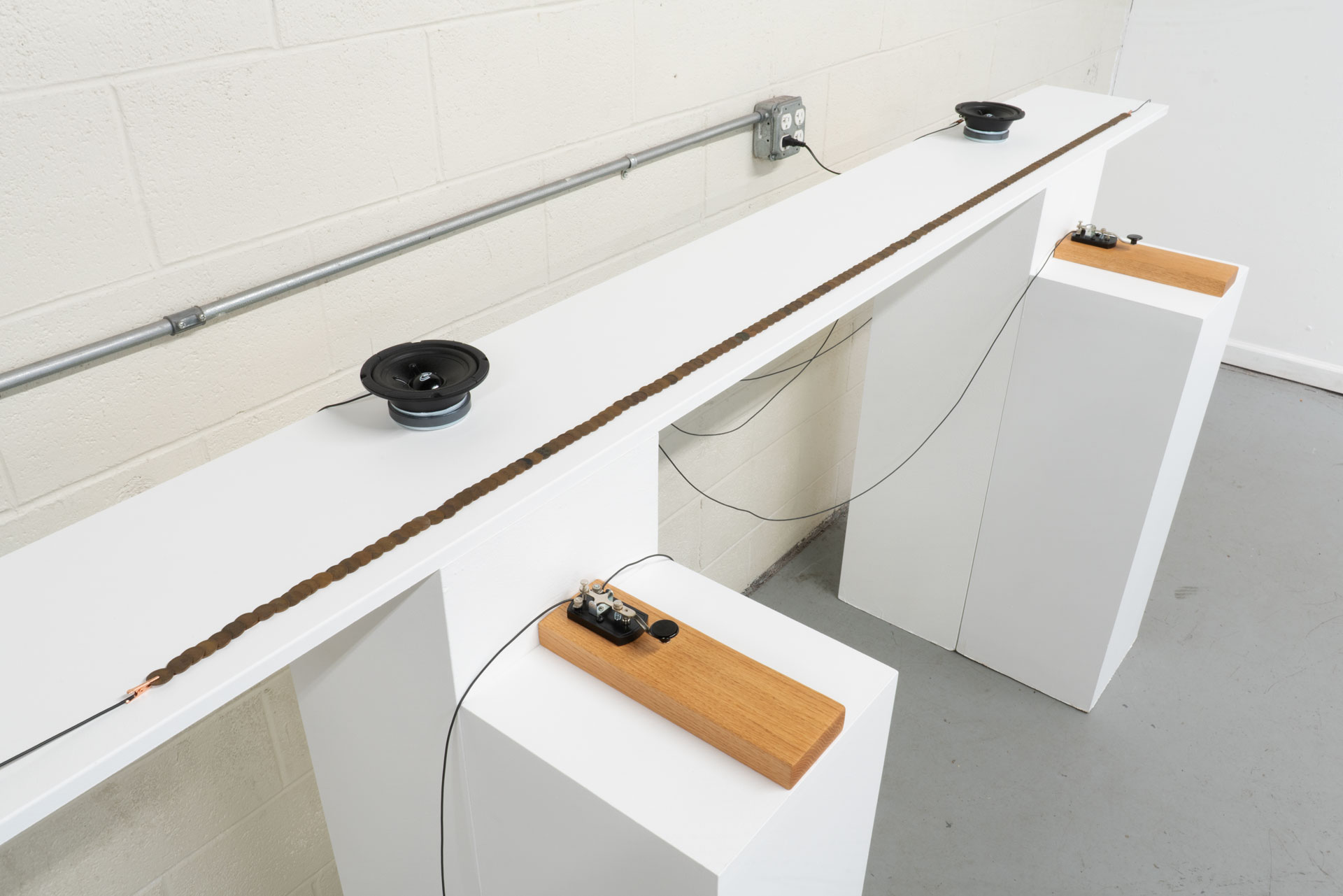
By depressing the telegraph keys, the electrical circuit that carries the audio signal through the pennies is completed and sound emerges from the neighboring speaker.

This memorializes the thousands of snow geese that died after landing in The Berkeley Pit—a defunct open-pit copper mine—during a brutal 2016 winter. The toxic waters cauterized their insides. Sulfuric acid (the ochre colors in the paintings) is the byproduct of extracting copper nanoparticles from copper sulfate. This acid was also commonly used in heap leaching. Copper oxide (the blue color seen in the paintings) was created by marinating copper plates in a bath of vinegar—about the same pH value as the water in the Berkeley Pit. These paintings are constantly changing as the acid and oxide both crystalize and slowly dissolve the cotton paper.